How to Read a Market Brief
Navigate the structure of a SentiSignal brief — key points, market impact box, and source articles.

Brief Structure
Every Market Brief follows a consistent structure designed for fast comprehension. Here is how to read one efficiently.
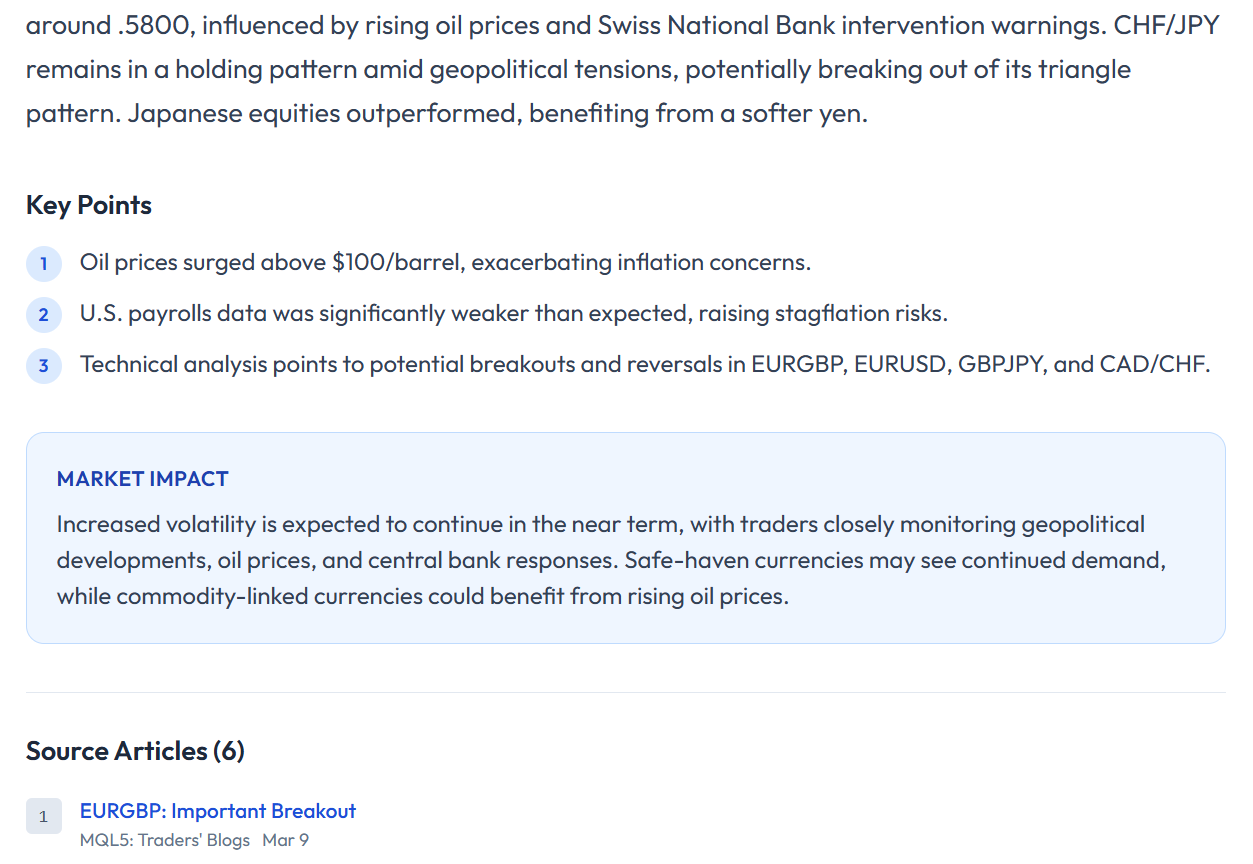
The screenshot shows a forex market brief. At the top (partially visible): narrative text about CHF/JPY and Japanese equities. Then two clearly structured sections: Key Points and Market Impact.
1. Headline and Narrative Summary
The brief opens with a headline (the main takeaway in one sentence) followed by a summary paragraph providing context. This is the brief's thesis — the central story being told. Read this first for orientation.
2. Key Points
Numbered bullets (1–3, maximum 5) extracting the most important discrete facts from the cluster. In the screenshot:
- 1. Oil prices surged above $100/barrel, exacerbating inflation concerns.
- 2. U.S. payrolls data was significantly weaker than expected, raising stagflation risks.
- 3. Technical analysis points to potential breakouts and reversals in EURGBP, EURUSD, GBPJPY, and CAD/CHF.
Key Points are ideal for rapid absorption — if you only have 10 seconds, read these.
3. Market Impact Box
A blue-bordered box with the heading "MARKET IMPACT" containing the AI's assessment of consequences for prices. From the screenshot: "Increased volatility is expected to continue in the near term, with traders closely monitoring geopolitical developments, oil prices, and central bank responses. Safe-haven currencies may see continued demand, while commodity-linked currencies could benefit from rising oil prices."
This is the AI's directional call — treat it as a hypothesis to validate, not a guaranteed forecast.
4. Source Articles
At the bottom: "Source Articles (N)" — a numbered list of the original articles that were synthesized into this brief. In the screenshot, Source Articles (6) are listed, including "EURGBP: Important Breakout" from MQL5 Traders' Blogs (March 9).
Click any source article to read the full original piece with its individual AI analysis. This is how you go from brief overview to source verification.
Reading Strategy
For maximum efficiency, use this reading order:
- Headline — 2 seconds: what happened?
- Key Points — 10 seconds: what are the facts?
- Market Impact — 10 seconds: what does the AI think matters?
- Source Articles — as needed: verify specific claims, read deeper
This flow takes under 30 seconds for the first three steps and gives you the full picture of the news cluster.